
Challenges in Computational Projects#
This section introduces the practical challenges when working on computational projects. Understanding these challenges provides context for the tools and approaches covered in this course.
Introduction#
Scientific computing projects face practical challenges that can significantly impact research progress.
Modern computational research brings transformative capabilities, but also introduces a range of practical challenges. These challenges stem from the fundamental characteristics of computational work: large data volumes, intensive processing requirements, complex workflows, and the need for transparency in scientific work.
Understanding why these challenges arise is the first step toward addressing them effectively. In this section, we examine the reality of computational project challenges across three main areas: resource limitations, task complexity, and reproducibility requirements.
Storage Limitations#
Storage challenges arise from fundamental physical and economic constraints in how data is persisted and accessed.
Non-volatile Storage Limitations#
Persistent storage, whether hard drives, SSDs, or network storage, has finite capacity. Each research group operates within allocated quotas because storage infrastructure requires physical space, power, and maintenance. High-performance storage systems that can handle concurrent access from many users are particularly expensive.
Additionally, data retention policies and backup requirements effectively multiply storage needs. A dataset that occupies 1TB might require multiple TBs when accounting for backups and versioning.
Volatile Storage Constraints#
RAM limitations often represent the practical bottleneck in data processing. While modern systems may have substantial memory, the amount required for large-scale analysis can exceed available resources. This is particularly acute when:
Datasets exceed available RAM, requiring out-of-core processing strategies
Multiple processes compete for memory on shared systems
Data structures in memory are larger than the raw data (e.g., sparse matrices, intermediate results)
The economic reality: RAM is significantly more expensive per byte than persistent storage, limiting how much can be made available.
Storage Quotas and Legal Constraints#
Storage quotas aren’t arbitrary restrictions, they reflect real operational constraints. Shared computing facilities must allocate resources equitably across many users and projects. Unrestricted storage by one project would disadvantage others.
Legal and regulatory requirements add complexity. Certain types of data (personal information, sensitive research data) may have restrictions on where and how they can be stored. This can limit storage options even when resources are available.
These constraints mean researchers must make strategic decisions about what to store, when to store it, and when to regenerate data instead.
Accessibility and Data Movement#
Data accessibility depends on both network infrastructure and physical proximity. Transferring large datasets across networks faces bandwidth constraints that can make certain workflows impractical.
A multi-terabyte dataset that takes days to transfer may make remote processing infeasible. Physical storage architecture affects performance significantly.
Key Terms
Latency: Time delay to access data
Throughput: Volume of data transferred per unit time
Data stored on local SSDs provides dramatically different access patterns compared to network-attached storage. Random access patterns can be hundreds of times slower on spinning disks compared to sequential reads.
These realities mean that where data resides relative to computation becomes a critical design decision. Sometimes the optimal strategy is to move computation to the data rather than data to the computation.
Working with Large Datasets#
Additional Considerations#
Large datasets introduce challenges beyond simple storage capacity. The time required to load, parse, and validate data becomes significant. A dataset that takes an hour to load means every experimental iteration includes that overhead.
Indexing
Creating data structures that enable fast lookup and retrieval of specific subsets without scanning the entire dataset. Similar to a book index that lets you jump directly to relevant pages.
When datasets exceed available RAM, processing strategies must change fundamentally. Instead of loading everything into memory, you need streaming approaches or batch processing. This increases code complexity and may limit which algorithms can be applied.
Data format choices become critical at scale. Plain text formats (CSV, JSON) may be convenient for small data but become impractical at larger scales due to parsing overhead and storage inefficiency. Binary formats optimized for scientific computing (HDF5, Parquet, Zarr) provide better performance but add complexity.
Effective indexing strategies can make the difference between practical and impractical workflows. Without proper indexing, finding specific subsets of data requires scanning the entire dataset.
Computational Constraints#
Spinning Threads
Independent execution sequences within a program that can run concurrently on multiple CPU cores.
Computational power faces fundamental physical limits that affect how quickly calculations can be performed.
CPU Limitations#
CPU performance stopped following simple exponential growth around 2005. Clock speeds plateaued due to power and heat constraints. Moore’s Law continues through increased core counts and architectural improvements, but single-threaded performance improvements have slowed dramatically.
This means that algorithms designed for sequential execution see diminishing returns from newer hardware. Performance gains increasingly require rethinking algorithms to exploit parallelism across multiple cores.
GPU Computing Challenges#
GPUs offer massive parallelism for suitable workloads, providing 10-100x speedups for some problems. However, GPUs present their own constraints:
Limited availability: Shared resources with high demand, particularly for modern high-end GPUs
Cost: High-performance GPUs are expensive, limiting how many can be deployed
Algorithm suitability: Not all algorithms benefit from GPU acceleration. Problems requiring frequent branching, small data volumes, or complex memory access patterns may see minimal improvement
Programming complexity: Effective GPU utilization often requires significant code modification
The economic reality: compute resources are finite and must be shared across many users and projects.
Specialized Hardware Requirements#
Modern computational problems increasingly benefit from specialized hardware beyond standard CPUs and GPUs:
Machine learning accelerators: Tensor cores in modern GPUs, TPUs, and specialized AI chips optimize matrix operations
High-memory systems: Some algorithms require extraordinary RAM capacity (terabytes) not available in standard machines
Fast interconnects: Distributed computing benefits from low-latency networking (InfiniBand, specialized fabrics)
The challenge is that specialized hardware represents significant capital investment. Facilities can only provide limited quantities, creating competition for access. Additionally, code written for one specialized architecture may not work on another, creating potential lock-in or requiring multiple implementations.
Researchers must balance the performance benefits of specialized hardware against availability constraints and development complexity.
Long Runtime Challenges#
Big O Notation
Describes how runtime grows with input size. O(n) is linear, O(n²) is quadratic (doubles input → quadruples time)
Long runtimes arise from the fundamental complexity of scientific problems. Many algorithms have computational complexity that scales faster than linearly with problem size. Doubling the problem size might quadruple or increase runtime by even more.
High-accuracy simulations often require iterative refinement, where each iteration depends on previous results. Convergence may require thousands or millions of iterations. Similarly, statistical methods like Monte Carlo simulation or parameter sweeps need many repetitions to achieve reliable results.
Practical Consequences#
Long runtimes change how you work:
Development cycle: You can’t quickly test changes and iterate. Each modification might require hours or days to validate.
Cost of failure: If a calculation fails after running for days, you’ve lost significant time and resources. Robust error handling becomes critical.
Debugging strategy: Traditional interactive debugging doesn’t work. You need logging, checkpointing, and the ability to restart from intermediate states.
Planning overhead: Results aren’t immediately available, requiring careful planning about what to compute and when.
These constraints push toward batch processing models, careful validation of small-scale tests before full runs, and robust automation to handle failures gracefully.
Task Multiplicity & Parallelism#
Ensemble Learning
Bagging: Bootstrap Aggregation reduces variance by training models in parallel on random subsets (e.g., Random Forest).
Boosting: reduces bias by sequentially training models with increased weights of misclassified data points in subsequent models (AdaBoost, XGBoost, Gradient Boosting, etc.).
Scientific computing frequently involves not just one computation, but many related computations. This task multiplicity arises naturally from the scientific method: testing multiple hypotheses, exploring parameter spaces, validating across different datasets, or running ensemble simulations.
Sources of Task Multiplicity#
Task multiplicity appears in several forms:
Batch processing: Applying the same analysis to many different input files or datasets
Parameter sweeps: Exploring how results vary across different parameter combinations
Ensemble methods: Running multiple simulations with varied initial conditions or parameters to assess variability
Pipeline stages: Multi-step workflows where different stages can potentially run simultaneously
Manual execution of multiple tasks quickly becomes impractical. Managing dozens or hundreds of related computations by hand is error-prone and inefficient.
Enabling and Exploiting Parallelism#
Simultaneously vs. Concurrently
Both terms mean “at the same time,” but simultaneously implies happening at the exact same instant, while concurrently suggests overlapping in time, often referring to parallel, coordinated, or extended processes.
Modern computing systems provide substantial parallel capacity through multiple CPU cores, multiple machines, and specialized architectures. However, exploiting this capacity requires that code and algorithms are designed for parallelism.
Why Parallelism Is Challenging#
Several factors complicate parallel execution:
1. Algorithm structure: Not all algorithms can be parallelized. Some computations are inherently sequential, where each step depends on the previous one.
2. Code architecture: Programs written for sequential execution often need significant restructuring to work in parallel. This includes managing how data is shared or distributed across parallel workers.
3. Overhead costs: Parallel execution introduces overhead from:
Splitting work across workers
Communication between workers
Synchronization to ensure consistency
Load balancing to keep all workers busy
4. Diminishing returns: Amdahl’s Law states that if a program has any sequential component, there’s a limit to speedup from parallelization. This fundamental principle quantifies the theoretical speedup limit when parallelizing a program. If a fraction s of the program must run sequentially, the maximum speedup with N processors is 1/(s + (1-s)/N). For example, if 10% of your code is sequential, the maximum speedup is 10×, no matter how many processors you add. This law emphasizes the critical importance of minimizing sequential bottlenecks.
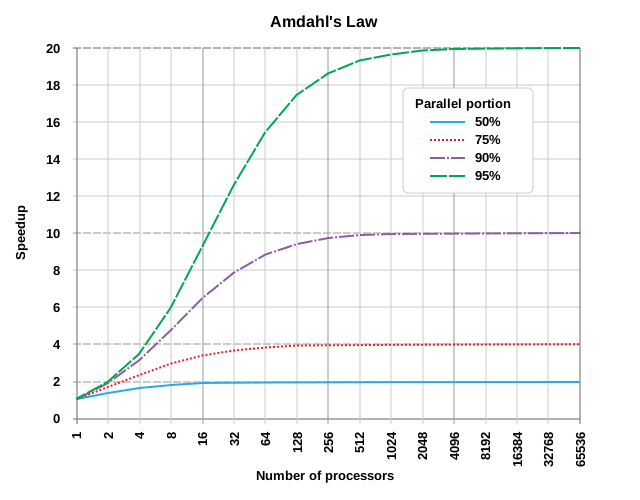
Theoretical speedup according to Amdahl’s Law for different proportions of parallelizable code. Even small sequential portions significantly limit maximum speedup.
Types of Parallelism#
Different types of parallelism have different complexity levels:
Embarrassingly parallel: Tasks that are completely independent. These are the easiest to parallelize and scale well.
Shared memory parallelism: Multiple threads working on the same data within one machine. Requires careful synchronization to avoid conflicts.
Distributed parallelism: Computation across multiple machines. Requires handling network communication and potential failures.
Each level introduces more complexity but potentially enables larger-scale computation.
Data and Workflow Management in Parallel Environments#
Parallel execution introduces significant data management challenges that don’t exist in sequential computation.
Race Conditions and Conflicts#
When multiple processes run simultaneously, conflicts can occur:
Write conflicts: Two processes attempting to write the same file simultaneously can corrupt data
Read-write conflicts: One process reading while another writes can see incomplete or inconsistent data
Resource contention: Multiple processes competing for the same resource (network bandwidth, disk I/O) can cause performance degradation
These require explicit coordination mechanisms: file locking, atomic operations, or architectural patterns that avoid conflicts (e.g., each process writes to its own output file).
Output Management#
Organizing results from parallel execution requires planning:
Naming conventions: Each parallel task needs distinct output files or a system to merge results
Aggregation: Combining results from many parallel tasks into final results
Partial results: Handling incomplete results if some parallel tasks fail
Data provenance: Tracking which outputs came from which inputs and parameters
Workflow Orchestration#
Complex workflows with dependencies between tasks require orchestration:
Task scheduling: Ensuring tasks run in the correct order when there are dependencies
Resource management: Allocating CPU, memory, and other resources across parallel tasks without oversubscription
Failure handling: Detecting when parallel tasks fail and deciding whether to retry, skip, or abort
Progress tracking: Monitoring which tasks have completed and which are still running
These challenges necessitate workflow management tools and careful system design to handle the complexity of parallel execution reliably.
Transparency & Reproducibility#
Computational reproducibility is the ability to obtain consistent results using the same data and code. It is fundamental to scientific integrity. However, achieving reproducibility in computational research presents substantial challenges.
Studies have shown that many published computational results cannot be reproduced, even when researchers attempt to reproduce their own work from months or years earlier. This reproducibility crisis undermines the scientific process and wastes resources.
Reproducibility serves multiple purposes:
Validation: Others can verify computational results
Extension: Future work can build on verified methods
Transparency: Reviewers and readers can understand exactly what was done
Error detection: Reproducibility attempts may reveal bugs or errors
Collaboration: Team members can work with consistent workflows
The challenge is that achieving reproducibility requires intentional effort throughout a project.
Creating Reproducible Workflows#
Reproducibility vs. Replicability
Reproducibility: Same results with same data/code
Replicability: Consistent findings with new data/independent study
Reproducible workflows don’t happen by accident. They require conscious design choices and documentation practices.
Documentation Requirements#
Reproducing computational work requires knowing:
Exact steps performed: What commands were run, in what sequence
Parameters and settings: All configuration choices that affect results
Input data specifications: What data was used, including versions and preprocessing
Decision points: How ambiguous situations or edge cases were handled
Incomplete documentation makes reproduction difficult or impossible. The challenge is that documenting everything feels like overhead during active research, but becomes critical when attempting to reproduce work later.
Workflow Design Decisions#
The structure of computational workflows affects reproducibility:
Manual steps: Interactive data exploration and ad-hoc analysis are difficult to reproduce exactly. What seemed obvious at the time may not be obvious later.
Implicit dependencies: If scripts rely on specific file locations, environment variables, or system state, these dependencies may not be apparent to someone attempting reproduction.
Non-deterministic elements: Some algorithms involve randomness. Without setting random seeds, results will vary between runs.
Reproducible workflows favor automation, explicit configuration, and deterministic execution where possible. This requires upfront investment in infrastructure and discipline.
Environment Consistency#
Computational results depend not just on code and data, but on the complete software and hardware environment in which computation runs.
Software Environment Challenges#
Software environments are complex ecosystems with many components:
Version dependencies: Scientific software typically depends on libraries (NumPy, SciPy, TensorFlow, etc.), which themselves depend on other libraries. Each component has multiple versions, and behavior can change between versions. A calculation that works with library version 1.2 might produce different results (or fail entirely) with version 1.3.
Operating system differences: System libraries, file handling, and process management differ between operating systems. Code developed on Linux may behave differently on macOS or Windows.
Compiler effects: For compiled languages or libraries with compiled components, different compilers or optimization levels can produce subtly different numerical results due to instruction ordering or precision handling.
The challenge is that tracking and reproducing the complete software environment is not straightforward. Simply knowing “I used Python” is insufficient; you need specific versions of Python, all installed packages, and potentially system libraries.
Hardware Variability#
Even with identical code and software, hardware differences can affect results:
Floating-point arithmetic: Different CPU architectures may handle floating-point operations slightly differently, particularly for edge cases. Accumulating small differences across billions of operations can lead to noticeable divergence.
Parallel execution: The order in which parallel operations complete may vary between runs or systems, leading to non-deterministic results if operations aren’t carefully ordered.
GPU computing: Different GPU models or drivers may produce subtly different results, particularly in reduced-precision operations.
Perfect bit-for-bit reproducibility across all hardware is often not achievable. The goal becomes ensuring scientifically meaningful reproducibility: results that match within acceptable tolerances.
Data Transparency and Availability#
Reproducibility requires access to the data used in computation. However, data sharing presents its own challenges.
Data Sharing Barriers#
Several factors limit data availability:
Size constraints: Large datasets (hundreds of gigabytes or terabytes) are difficult to share. Storage and bandwidth costs make wholesale data sharing impractical in many cases.
Privacy and sensitivity: Research involving human subjects, proprietary information, or sensitive data cannot be freely shared due to ethical or legal constraints.
Intellectual property: Data may represent significant investment and competitive advantage, limiting sharing incentives.
Data rights: Researchers may not have permission to share data obtained from other sources.
Preprocessing and Provenance#
Even when raw data is available, reproducibility requires documenting all preprocessing and transformation steps. Data cleaning, normalization, feature extraction, and filtering all affect results. If these steps aren’t documented or provided in executable form, reproducing results becomes difficult.
Pre-trained Models#
Machine learning introduces additional complexity. Pre-trained models represent the compressed knowledge from training data, but the training data itself may not be available. This creates challenges:
Black-box uncertainty: Understanding what the model learned and its limitations requires knowing about training data
Bias propagation: Biases in training data affect model behavior, but aren’t visible without access to that data
Domain applicability: Knowing whether a pre-trained model applies to a new domain requires understanding the training data distribution
Transparency in data (or at minimum, comprehensive documentation of data characteristics, sources, and preprocessing) is essential for meaningful reproducibility.