
as a Service#
Usage & Origins#
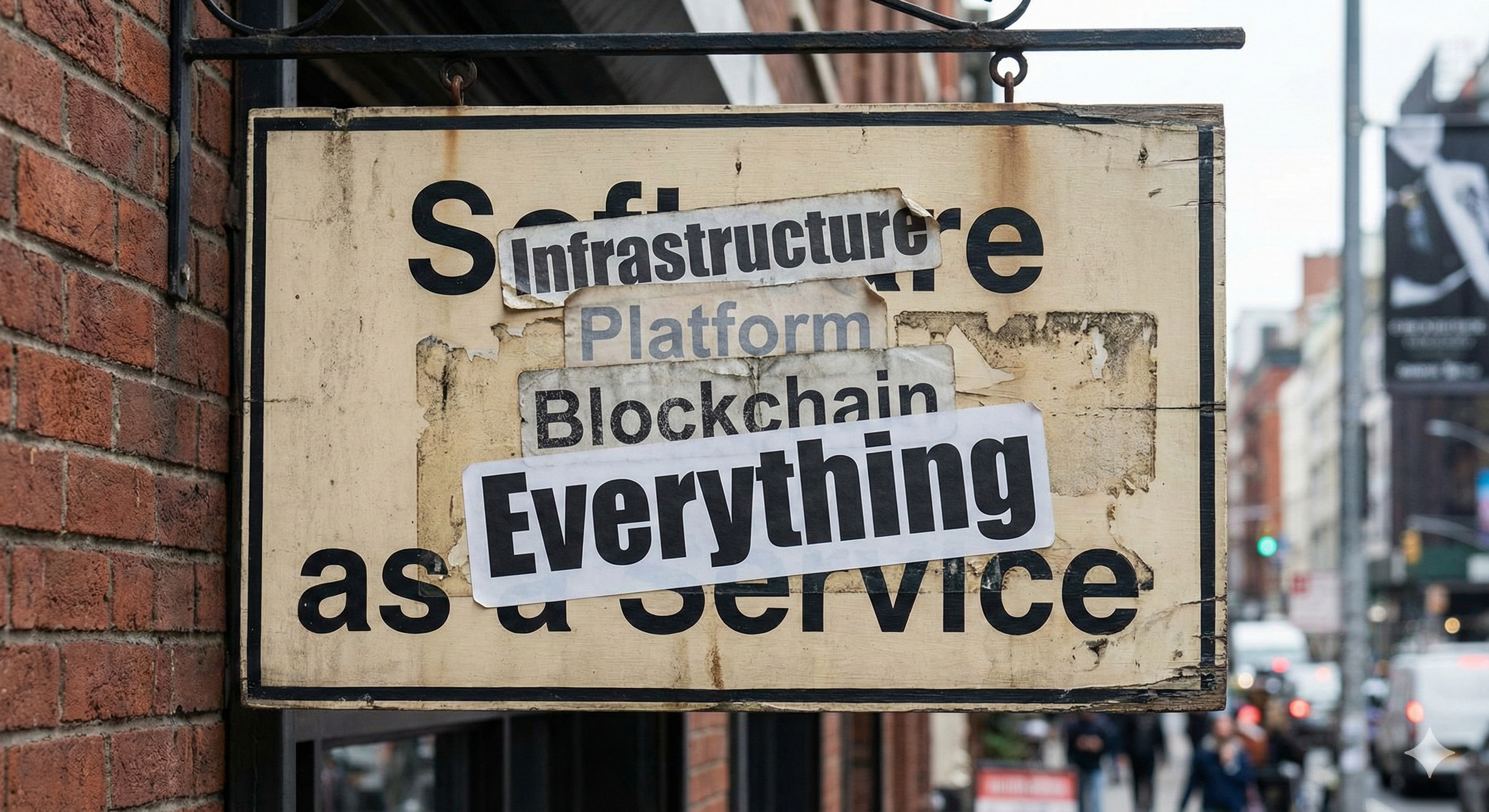
The phrasal template arguably originated from the concept of Software as a Service (SaaS) and has since been broadly applied to subscription-based business models. As of February 2026, the template’s own Wikipedia page1https://en.wikipedia.org/wiki/As_a_service lists over 35 distinct business models using this nomenclature.
In a scientific context, especially in computational sciences, this paradigm has considerably altered research infrastructure. It shifts the heavy burden of managing physical hardwar like power, cooling, maintenance, and networking, from the scientist to specialized providers. This allows researchers to treat computing power not as a piece of equipment they must buy and repair, but as a flexible utility they consume. Consequently, scientists can focus on their specific domain questions rather than the intricacies of IT administration.
Infrastructure as a Service#
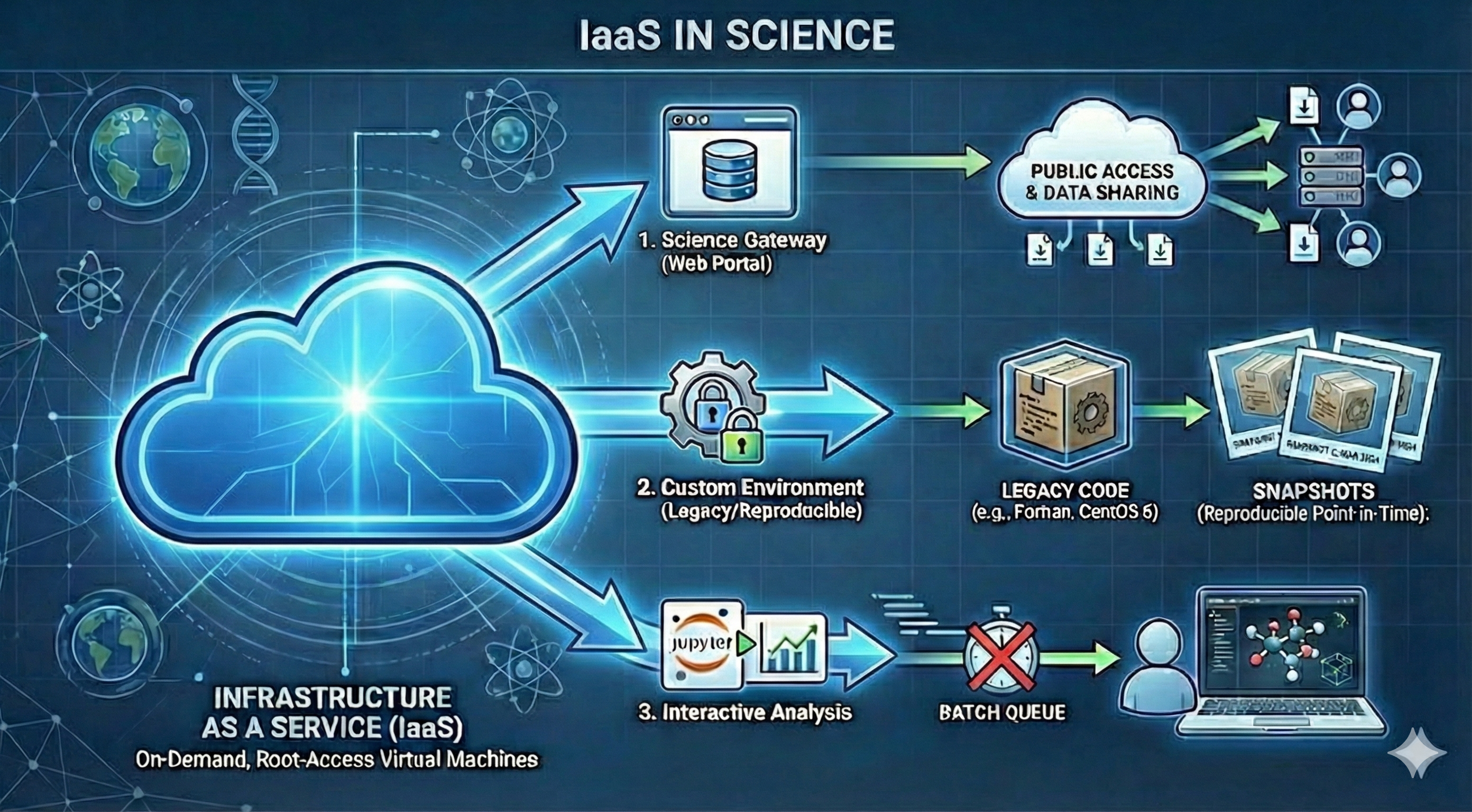
This model provides fundamental computing resources, such as virtual computers, block storage, and networking, in a fully virtualized manner. Ideally, it offers the user full administrative control (root access) from the operating system upward, creating the impression of maintaining a dedicated, private machine.
This approach allows for the usage of computers on demand without the need to purchase or maintain physical hardware. The virtualization layer enables flexible resource scaling, instant backups of entire machines (snapshots), and the easy sharing of data across resources.
In science, IaaS serves as a on-demand multi-purpose computer. Unlike rigid supercomputing clusters, IaaS allows researchers to:
Ensure Reproducibility: Spin up Virtual Machines (VMs) with specific, legacy operating systems to run older scientific code that might break on modern clusters.
Host Science Gateways: Run web servers, databases, and APIs that allow the global community to access and interact with research data.
Perform Interactive Analysis: Launch powerful, persistent workstations for exploratory data analysis (EDA) that do not require waiting in a batch queue.
HPC as a Service#
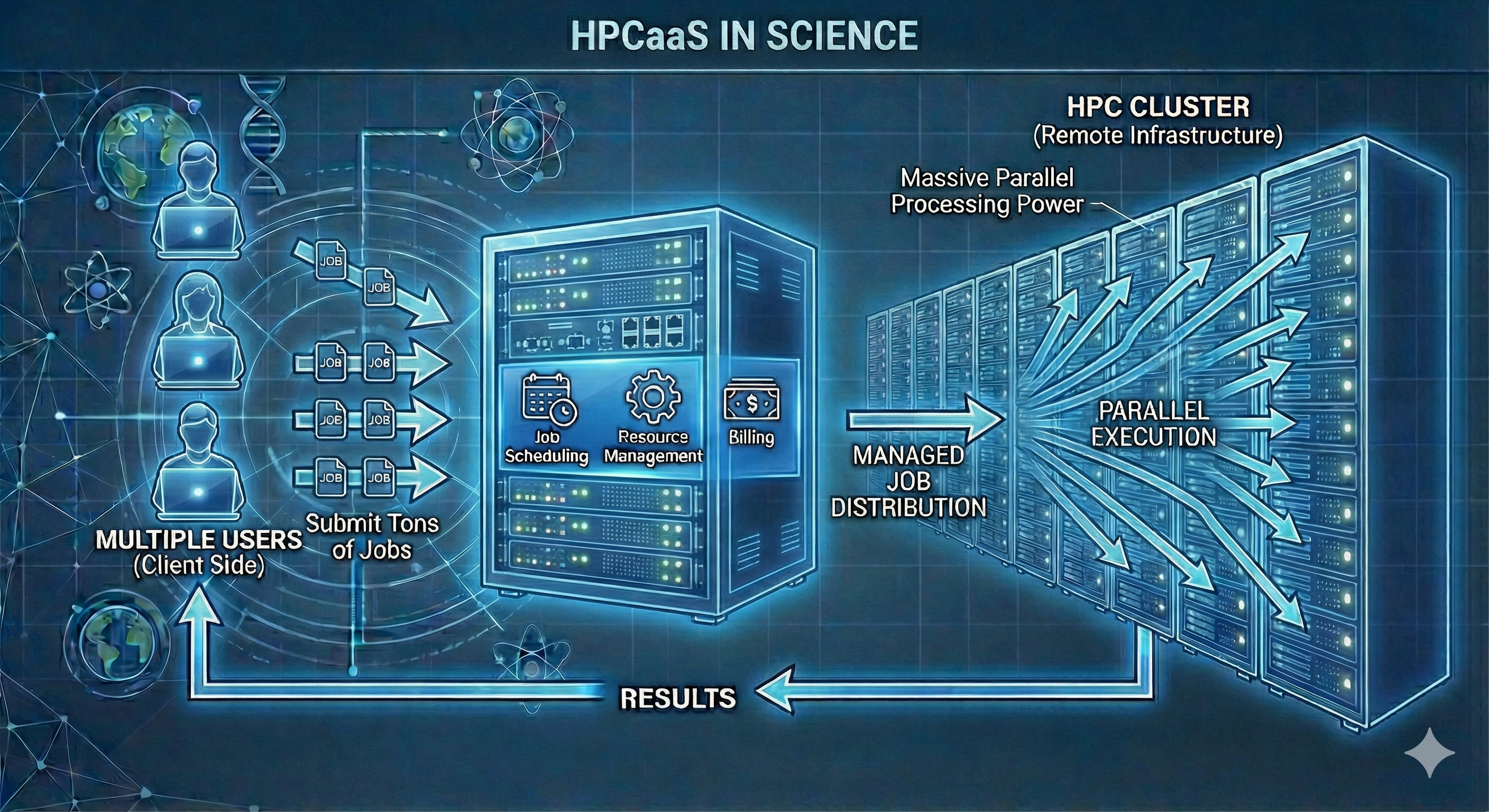
In High Performance Computing (HPC), multiple independent computers (referred to as “nodes”) are aggregated to act as a single system, enabling concurrent (parallel) and distributed processing at a massive scale.
The resulting clusters (also referred to as supercomputers, or high performance computers) form the backbone of modern research infrastructure and have become a cornerstone of advanced IT, particularly in the training of Artificial Intelligence models.
To build a performant cluster, HPC relies heavily on ultra-low latency communication between nodes. Consequently, specialized high-speed interconnects (networking) are just as critical to the system’s speed as the processors themselves.
In this ecosystem, the network acts as the central nervous system. Unlike standard cloud computing, where web servers operate independently, HPC workloads are often tightly coupled. If one node in a 1,000-node simulation is delayed by a fraction of a millisecond, the entire simulation stalls. Thus, HPC is not just about raw calculation speed; it is about the synchronized harmony of computation.
High Performance Computers play a crucial role in computational science and serve as a source of discovery for phenomena that are:
Too large (e.g., simulating the collision of galaxies).
Too small (e.g., modeling quantum interactions between electrons).
Too slow (e.g., modeling climate change over the next 100 years).
Storage as a Service#
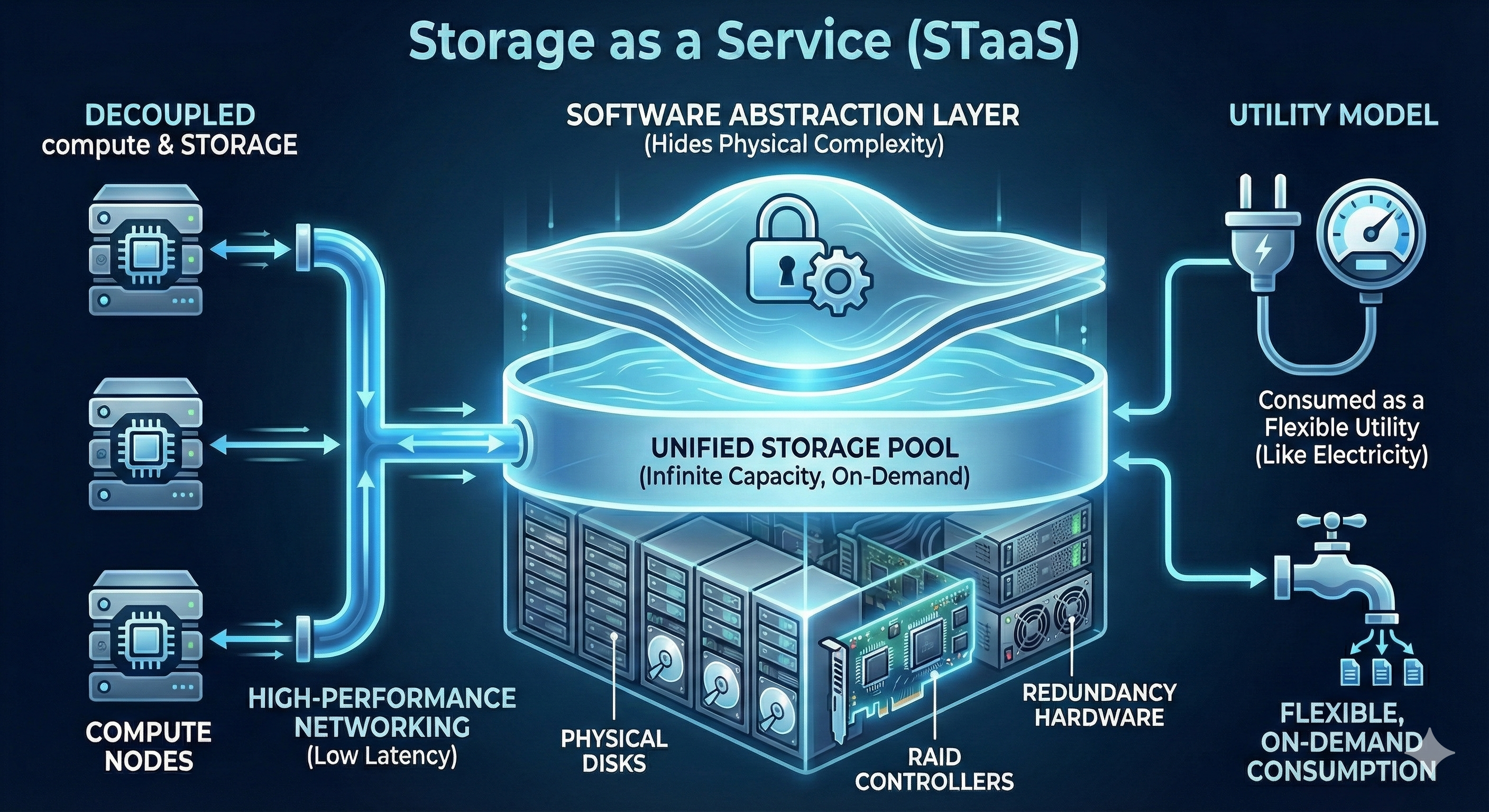
Storage as a Service (STaaS) changes data management by decoupling storage capacity from individual compute nodes. Instead of managing physical disks attached to servers, users consume storage as a flexible, on - demand utility, much like electricity. Also here, the principle is to abstract the physical complexity of hard drives, RAID controllers[1], and redundancy is hidden behind a software layer, allowing the system to present a unified pool of infinite capacity.
For STaaS to function effectively, it relies heavily on high-performance networking, as data must travel instantly between the storage pool and the compute nodes without inducing latency that would starve the processors.
This model represents a major technological shift from Hardware-Defined to Software-Defined Storage (SDS). Historically, large-scale storage relied on rigid, proprietary Storage Area Networks (SAN)—expensive, monolithic hardware arrays that were difficult to scale. Today, modern infrastructure has pivoted to software solutions like Ceph, which run on standard “commodity” servers. Ceph aggregates these generic servers into a self-healing cluster, using intelligent algorithms to distribute data. This allows administrators to scale storage from terabytes to exabytes simply by adding more standard servers, without ever taking the system offline.
Sources:
https://en.wikipedia.org/wiki/As_a_service
https://en.wikipedia.org/wiki/Infrastructure_as_a_service
https://en.wikipedia.org/wiki/High-performance_computing
https://en.wikipedia.org/wiki/Software-as-a-service
https://www.ibm.com/think/topics/storage-as-a-service